Over the last four years, I’ve published over 130 pieces, invented dozens of concepts and frameworks, and built an entire productivity philosophy from scratch. It’s getting harder to find your footing on here. This post is your map.
If you haven’t already done so, also check out my ABOUT page for more background on who I am, plus the Atlas to browse posts by category and the Lexicon to browse by index.
A collage of some of my most important essay title images.
The Foundation: Fractal Productivity
I started this Substack based on a simple idea: that personal productivity is fractal. I only much later wrote a piece that actually explained what fractals are:
Fractals — mathematical shapes that repeat the same patterns at every scale — can be applied conceptually to abstract ideas, and when you spot two or more concepts from different levels of abstraction that are self-similar, you've found a "conceptual fractal."
But from the beginning, fractals were always part of my writing. Fractal Productivity was the initial name of this Substack and the name of the very first piece on here:
A "personal program" is a grand, finite, transformative campaign that sits one magnitude above ordinary projects — think marathons, master's theses, or house renovations — unified by a single central outcome and a built-in capacity to change who you are. The essay defines the concept, distinguishes it from mere "big projects" through examples and counter-examples, and lays out a practical management framework covering naming, scoping, planning, and organizing these rare but high-leverage personal endeavors.
If you read one thing from this section, make it this one.
Magnitude Tuning
After that, I explored a practice I had never seen before elsewhere. I called it magnitude tuning, and I wrote 4 pieces about how I used it to improve my goal-setting, weekly reviews, and other parts of my productivity system.
Magnitude tuning is the practice of deliberately matching the size and abstraction level of your productivity routines to the thinking level they actually require — so a daily review operates at day-scale thinking, not year-scale, and a task stays a task instead of ballooning into a project. Drawing on reading theory, computer science abstraction, and expertise research, the essay argues that most productivity failures are failures of level, not effort.
I experimented a lot with PARA over the years, having been part of many of the creator’s online cohorts, and even moderated one. Over time, I identified many ways to improve the method without breaking its core invariants:
I then ported an email newsletter series I had written many years earlier and turned it into a long series on building a smart task management system. If you want a ground-up approach to how tasks, lists, and inventories fit together, this is it. The series included, among others, my idea of a digital inventory.
After that, I shifted my focus back toward PKM and “second brains.” If you don’t know what these topics are about, these two short intros cover the basics:
And I reported in detail on my painful migration from Evernote to Obsidian — useful if you’re considering the same move or just want to understand what switching a PKM system actually costs:
Several years later — now — I no longer use PARA or ACE because I built my own organization method called ±PEAKER. If you struggle with digital organization in any form, this is where to start:
Digital organization has evolved through four ages — from archiving to action to sense-making to the current Awareness Age — and no existing method (PARA, ACEx) fully handles all four demands at once. ±PEAKER is my answer: an eight-space organizational framework (Inbox, Outbox, Protocols, Efforts, Arcade, Keep, Exclave, Records) designed not just to store or ship, but to align your system with your values, roles, and evolving identity over time.
Another big arc in my writing is goal-setting. I wrote quite a bit about it over the years — from the mechanics of how to set better goals to the deeper question of what goal-setting is actually for:
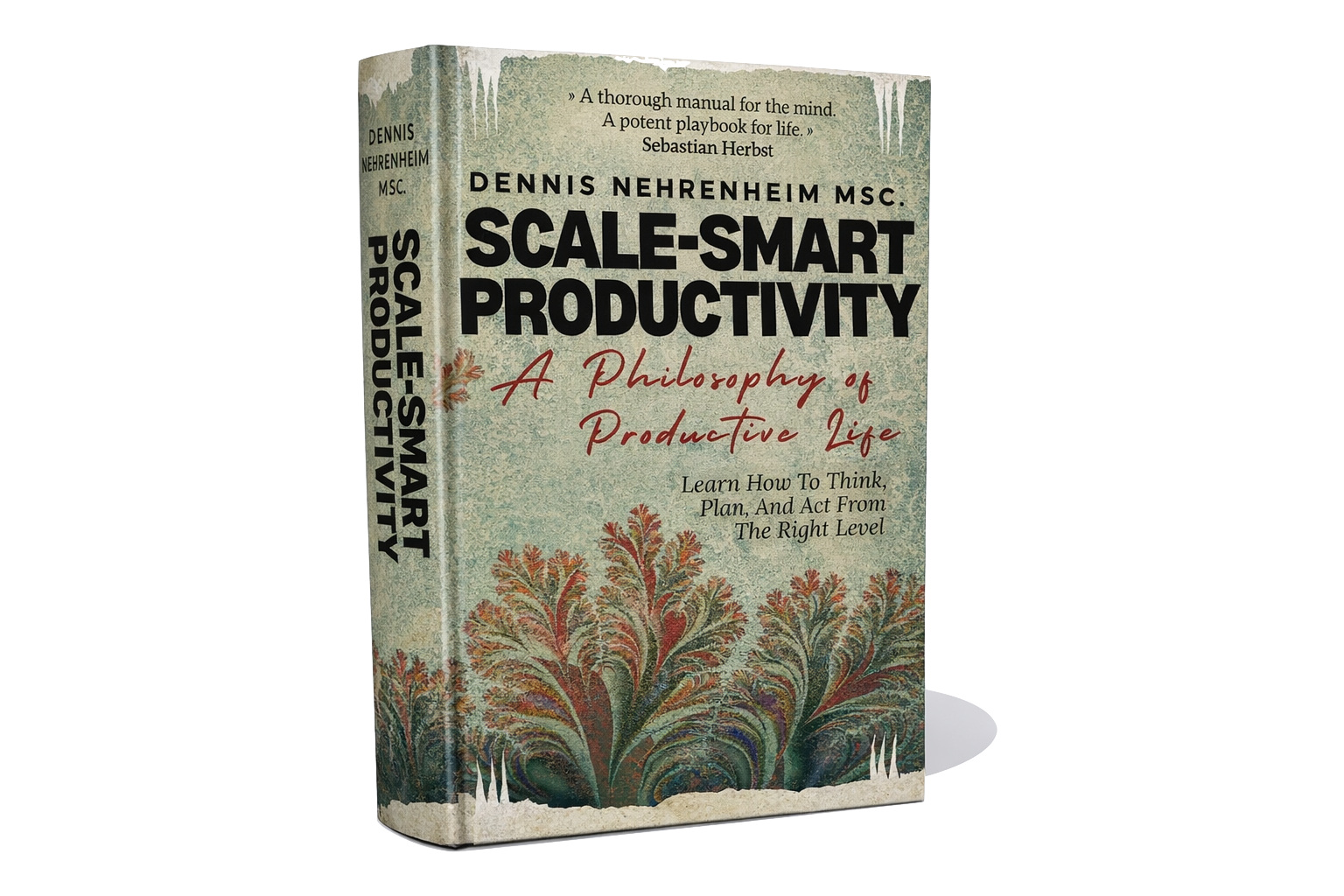
All of this prepared me to shift gears away from just “fractal productivity” to something bigger. I realized that the personal productivity “industry” is broken. And I tried to wrestle with how to save it. That work led to my book, which after several title changes arrived at its final name: Scale-Smart Productivity: A Philosophy of Productive Life — How To Think, Plan, And Act From The Right Level.
Aspirations — vague, value-laden, high-altitude pursuits like "become a great writer" or "parent a child" — need more than a bucket list; they need a structured garden organized across universal life realms and clusters called Arcs of Aspiration, large-scale transformative storylines you consciously author over a lifetime. The essay argues that tending this garden through regular contemplation and a "reap-when-ripe" strategy is the missing top layer of any serious productivity system — the ceiling that gives all lower-level action its meaning.
Bridging the gap between lofty aspirations and daily action requires more than intention — it demands heartfelt commitment, which is both an intellectual decision and an emotional entanglement with a cause that genuinely matters to you. The Dedication Method structures this through three layered lists — tagged aspirations (macro), a flexible Moving Target Board (meso), and a locked Ubermind Agenda (micro) — forming a sandwich model that centralizes change at the middle layer so that black swans and new opportunities never destabilize your long-term direction or your near-term execution.
Most productivity systems focus entirely on execution while ignoring the aspirations and commitments that give it direction — the Triple E Game Plan corrects this by splitting day-to-day work into three distinct processes: engaging (preparing commitments for action), executing (staying immersed in the work), and escalating (reacting to unexpected obstacles without breaking flow). Together, these three moves form the ground-level layer of the ACE framework, where "cocooning" against distraction and "fractalling out" to your commitment layer when in doubt keep you moving in the right direction even when reality gets messy.
My first post appeared on April 27th, 2022 — almost four years ago. My latest series from March 2026 is called Scale-Smart Moves, and it feeds ideas from the book back into the blog. If you want to see the framework applied as practical, single-concept essays, start here: