

Today I want to dive into a second raw example of magnitude tuning™️. In the previous post, I showed you how I optimized my weekly reviews. Today I will guide you through how my goal-setting practice has evolved over the years.

Goal setting is often a less structured process than reviewing a week. We often can’t or won’t work from checklists, making it somewhat harder to compare our goal-setting practices across time.
That is why comparing the output of goal-setting—the actual goals we set—may be a better basis. We can evaluate how the content and structure evolved over time.
Luckily I kept a log of all the yearly goals I set for myself for the last ten years.
Keeping such a log is a great way to contemplate your progress, and it is the only reason I am able to write this article. It’s also a great example of when a someday-maybe empire pays off.
So, let’s dive into my personal goal-setting odyssey.
Bootstrapping my annual goal-setting practice
My goal-setting practice for the year 2014 was the earliest I could dig up. It was probably the first time I wrote down goals digitally. This is a screenshot directly from my personal knowledge companion at the time:
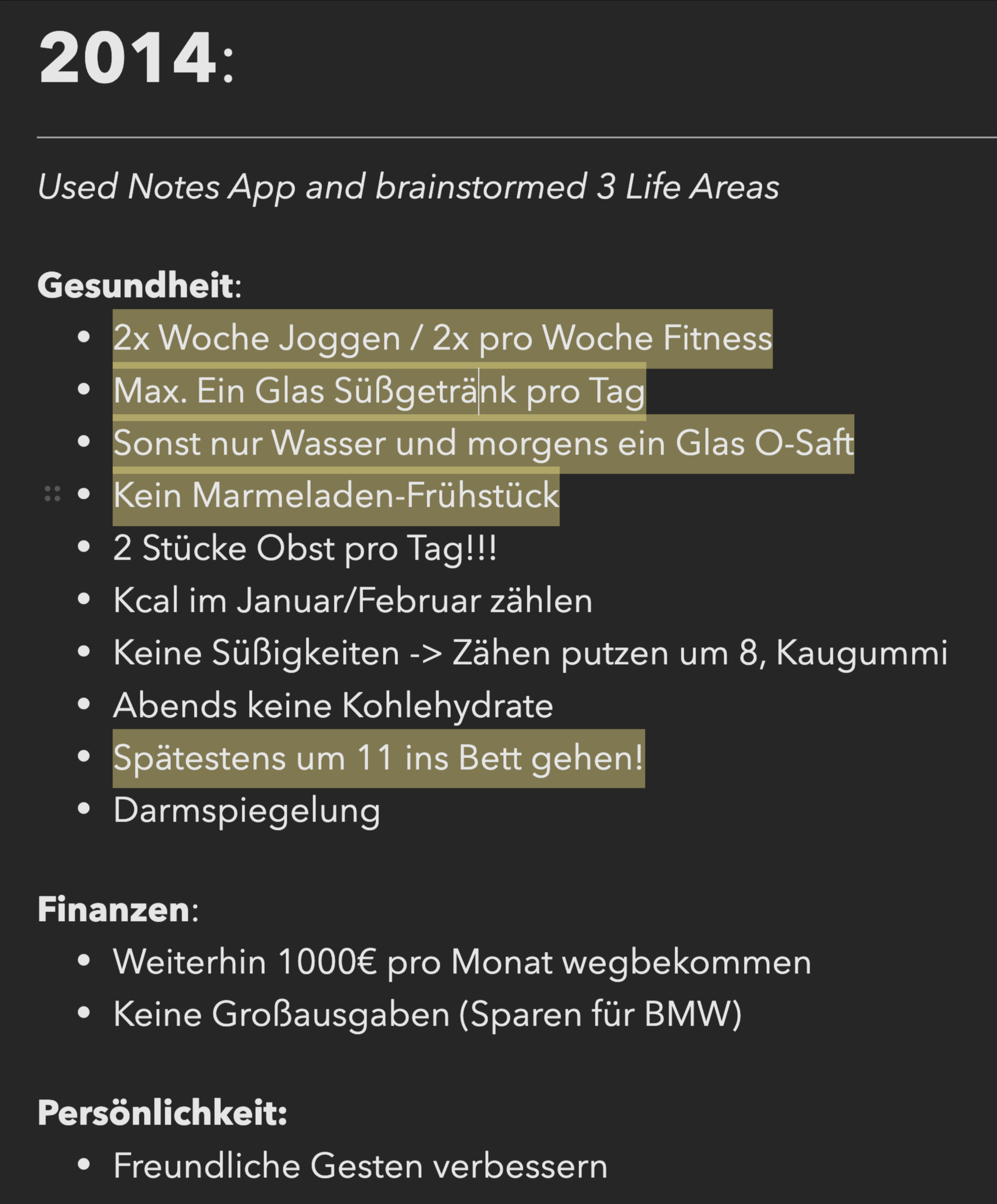
Even if you don’t speak German, you can probably tell that my “goals” had a rather random shape. I didn't know anything about goal setting back then, and I didn't use S.M.A.R.T. goals. I listed way too many of them, some too small and others quite big. I have mixed standards to maintain, with unclear projects and vague intentions.
In fact, looking at this now, these would probably better be called "New Year resolutions". And as you can guess, a lot of them were not realized. That by itself isn’t dramatic. After all, we’ve got to start somewhere. The true problem was that at the end of that year, I didn’t look back. I didn't analyze what was going wrong in order to improve from there. I just knew that it didn’t work.
So, I gained no faith in my system and went with a completely different approach in 2015. This time, I didn’t set resolutions but focused on the biggest decision I would face that year. I would graduate that year and be trying to find out what occupation to take on afterward. My “goal setting”, again, was completely free-form. It included drawings like this:
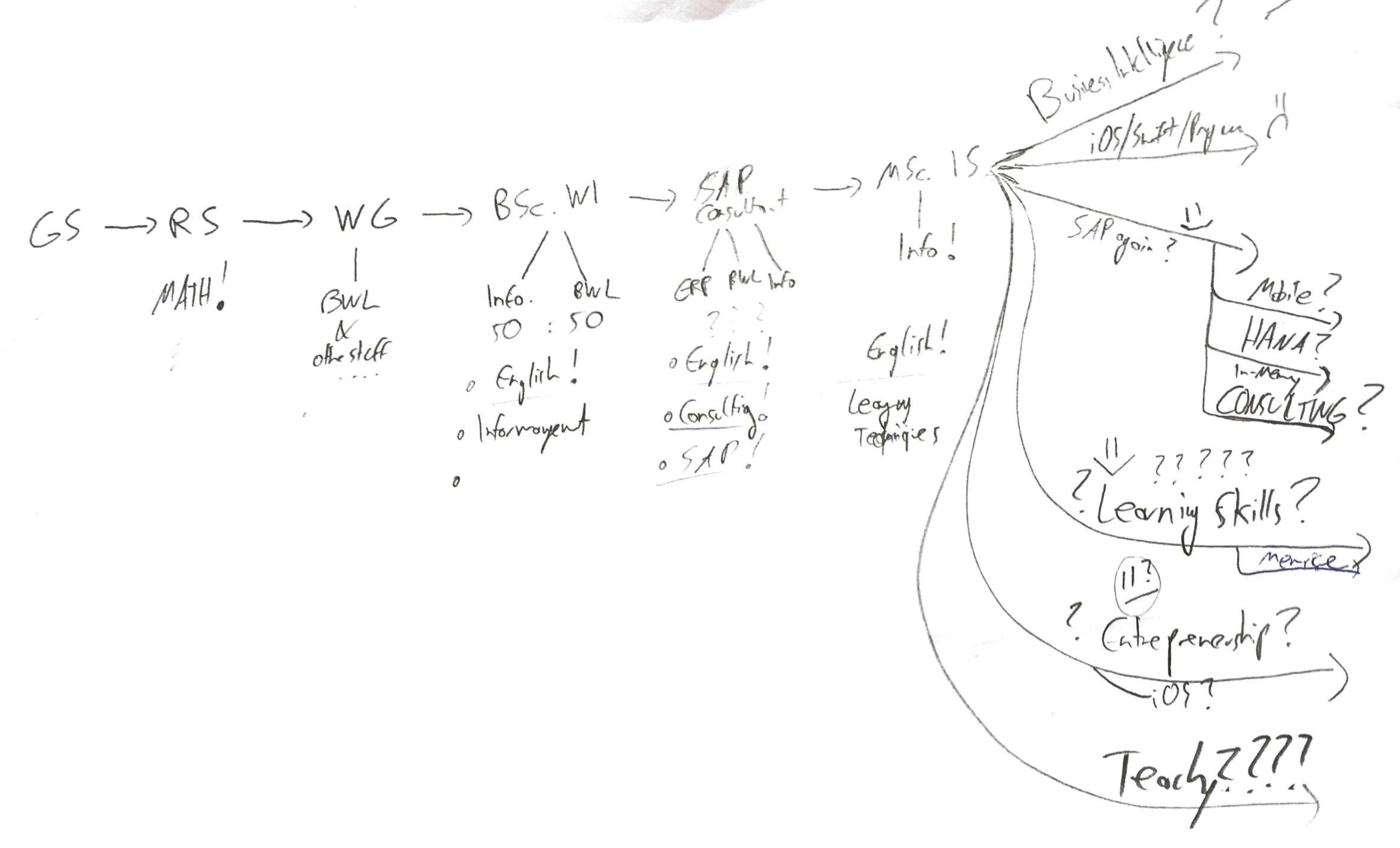
Contemplating the biggest decision of the year worked well for me since I was happy with what I chose. However, that year again didn’t improve my goal-setting. So, once again, in 2016, I went in a completely different direction. I tried to set up what I called a “strategic vision board”. Now I was more ambitious. I wanted to distribute my dreams and targets in the upcoming years.
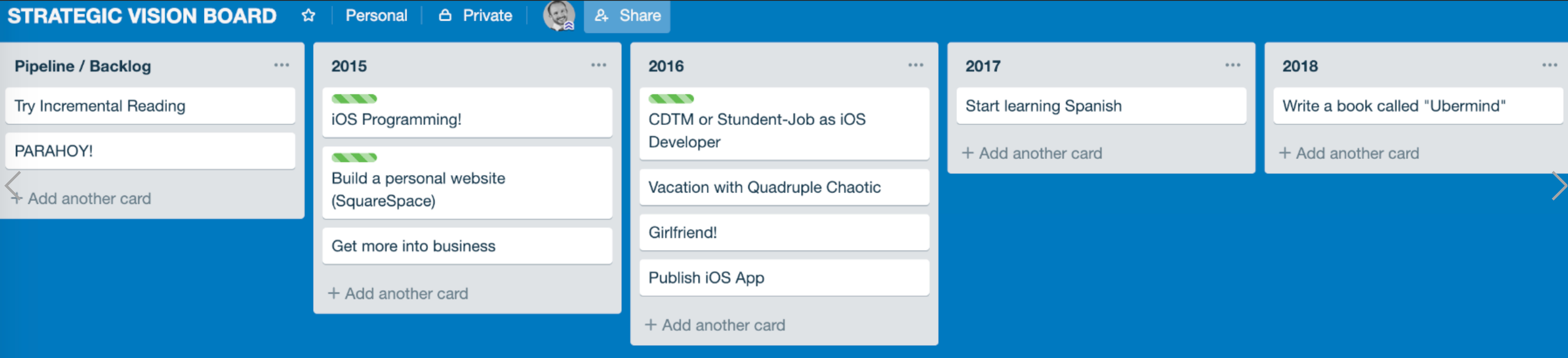
But while high in motivation, this was the worst year yet. Of my four “goals” exactly zero came true! And of course, I mean look at that: one of my “goals” was called “Girlfriend!”. Once more, I completely missed the point.
Then things finally started to change. After three failed attempts in 2017-2018, some structures finally started to emerge. In 2017, I tried to budget how much attention/energy I would like to distribute to certain areas of my life. Again, I wasn’t setting goals, but I was starting to build up some structure.
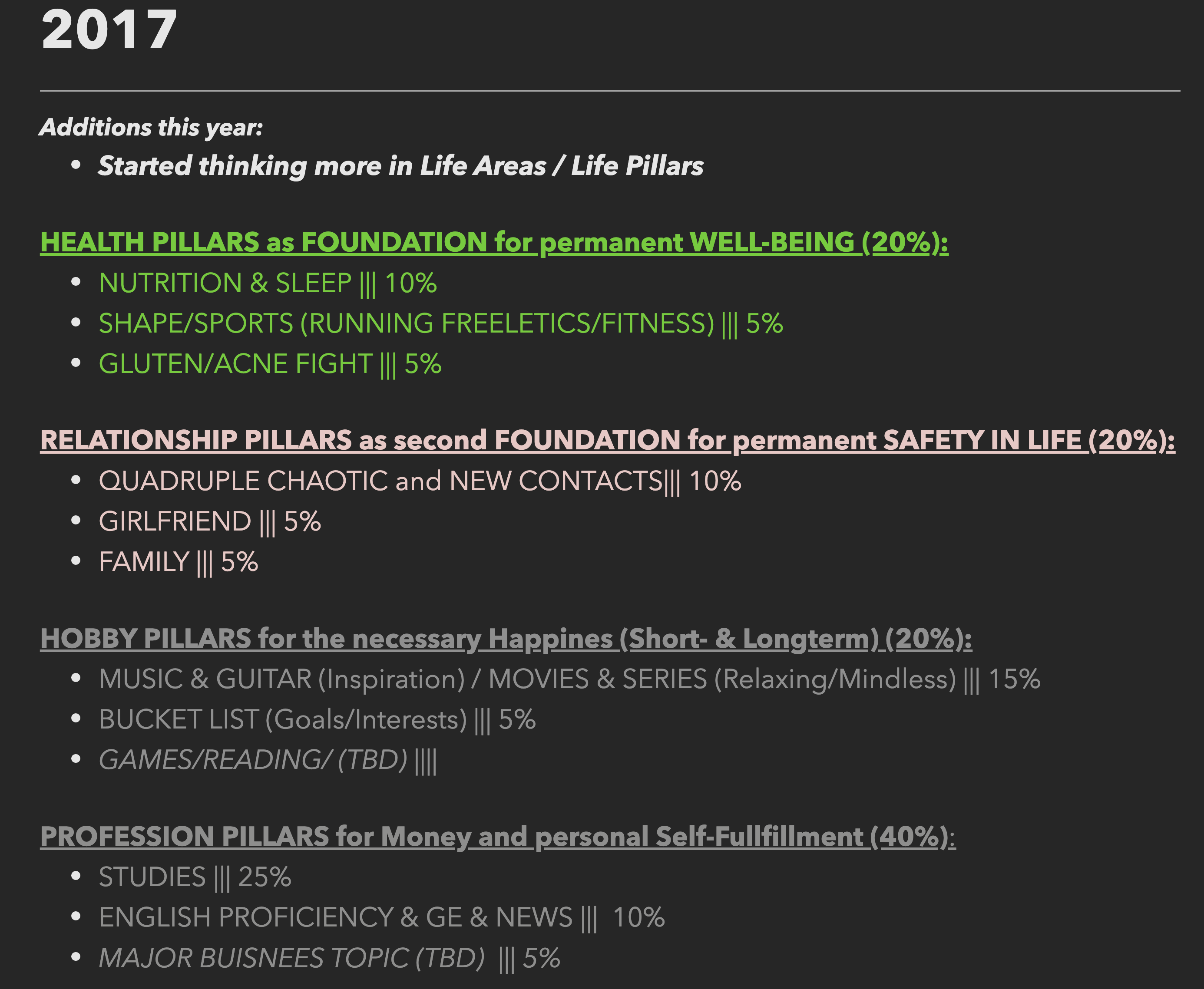
To recap, 2014-2017 were quite experimental. The success rate was subliminal. I had absolutely no idea what I was doing. I got a lot of stuff done, but it was completely unrelated to my goals. And my goal-setting didn’t help with any of my achievements.
Yet now I had at least a structure. The fact that I could iterate on the version from 2017 gave me the confidence to finally settle on a way of setting goals. My new earned structure helped me in 2018 find my “life realms” — 6 big domains through which I interpret my life and that guide me in distributing my energy and time.
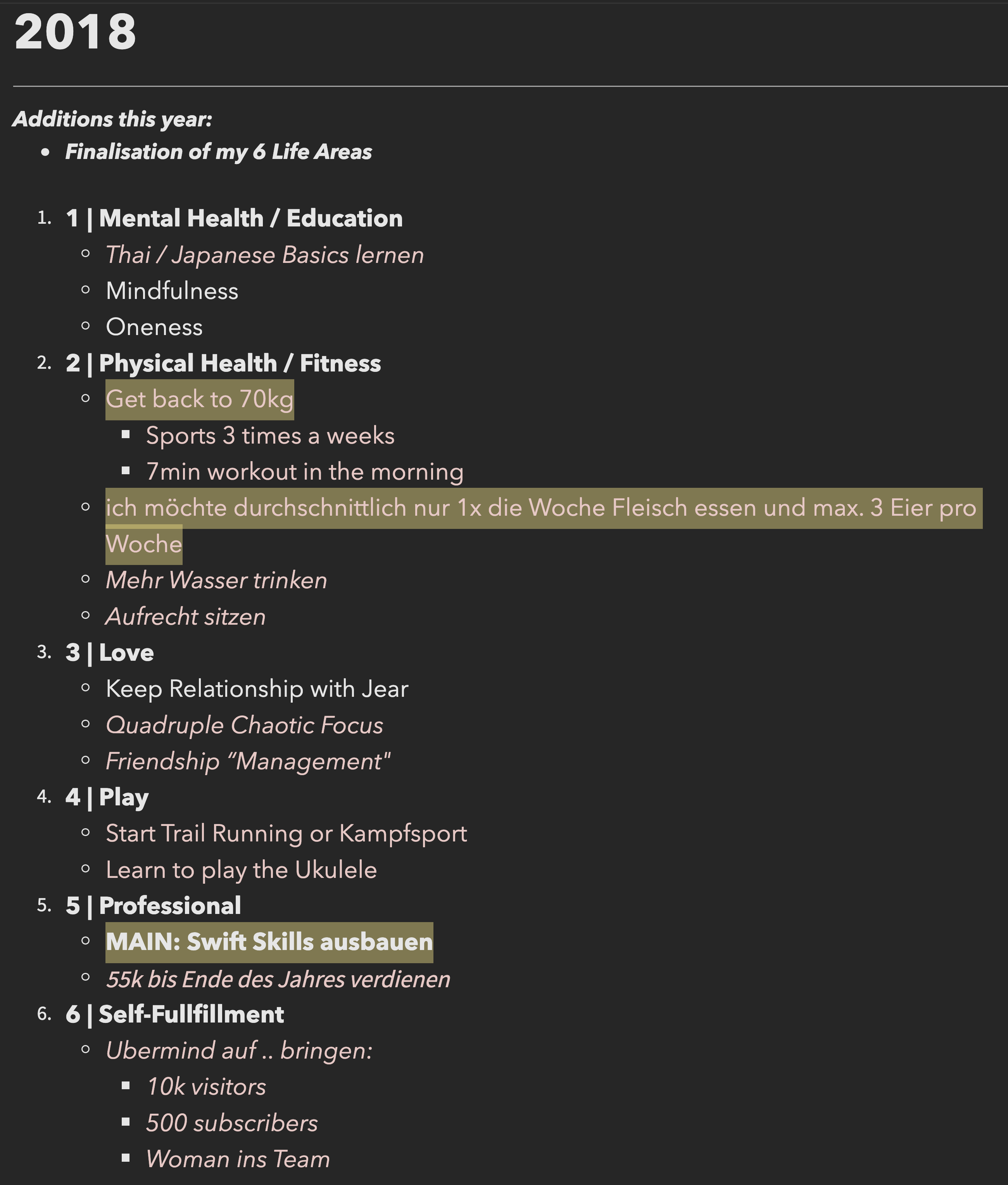
At the end of 2018, my “goals” were still somewhat vague resolutions. But now, at least, I had a fixed scaffolding, and my approach to goal setting started to crystallize in a distinct direction. That’s why I consider 2019 the year when things finally changed for me. With a fixed structure in place, I now had the freedom to focus on the content, i.e., the goals themselves. I set clear, measurable, time-bound goals instead of vague resolutions or aspirations. I even estimated their “size & difficulty” indicated by the number of "★s.
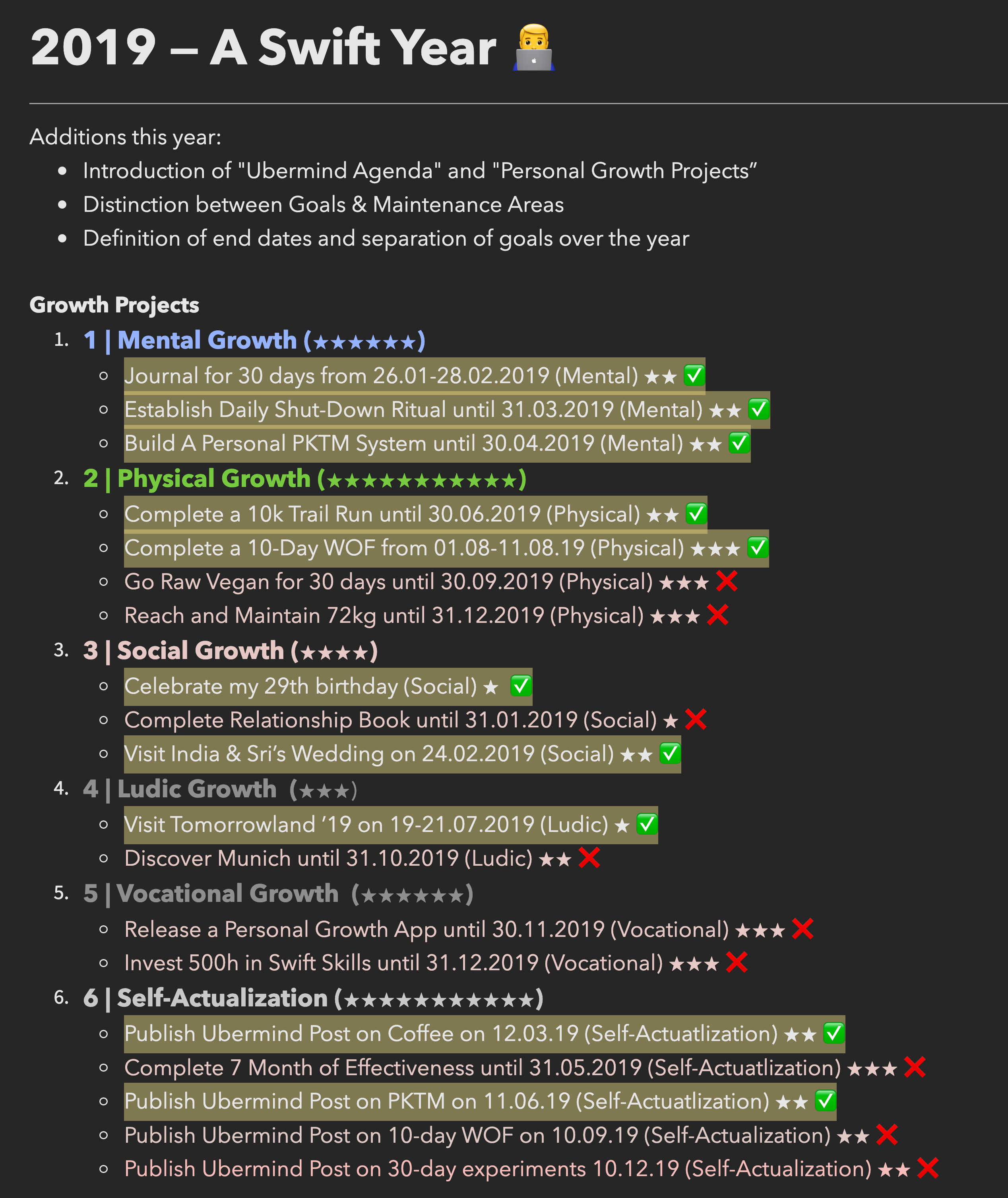
Overall, my goals started to look way more solid. This motivated me to start 2020 by looking back and zooming out. I asked what went wrong with the goals I didn’t achieve and drew some learnings from it. But the most important change that occurred that year was that I settled on a system I would iterate on instead of trying something completely different every year. Because this unlocked magnitude tuning.
So, in a sense, what I showed you today was only a prelude. It includes some elements of magnitude tuning, but the real progress happened afterward. That’s one of the reasons why I call this technique magnitude tuning. It's more of a fine calibration on the surface of things. It's about efficiency, not effectiveness. It's more like facelifting a car, not about replacing its engine.
This implies that for magnitude tuning, you need a solid foundation to start from. I bootstrapped my goal-setting practice from the ground up, which is why it took me more than five years to reach a point of tunability.
You can probably skip some of my detours by copying a trusted system from someone else. But as I mentioned before, you may still need a couple of iterations to really integrate it into your life.
That’s it for today. In the next post, I will continue this discussion and show you how I applied magnitude tuning to find my personal goal-setting cadence, which includes not only annual goals but also weekly and quarterly ones.