

A few days ago, I introduced you to magnitude tuning™️. To round off this introduction, I want to give you detailed and raw examples of my personal life. Magnitude tuning is not limited to what I am to show you. But I wanted to pick the most vivid and tangible examples from my personal life.
In particular, we will look at...
how I tamed my digital hygiene routines (weekly, monthly, quarterly reviews)
how I found my personal goal setting cadence (weekly, quarterly, yearly goals)
+ maybe more...

Let's look at the most vivid magnitude tuning example there is: weekly reviews.
A weekly review usually contains some steps to clear inboxes. The weekly cadence is a good fit for most since it doesn't allow for too much stuff to accumulate while still being regular enough to not let things fall through the cracks.
Of course, everyone is different. Some may need reviews only every two weeks, some twice a week, and some irregularly. And some may want to use the power of this mighty ritual for more than just clearing inboxes. I was one of them…
That’s why, at one point, I had a weekly review that looked like this:
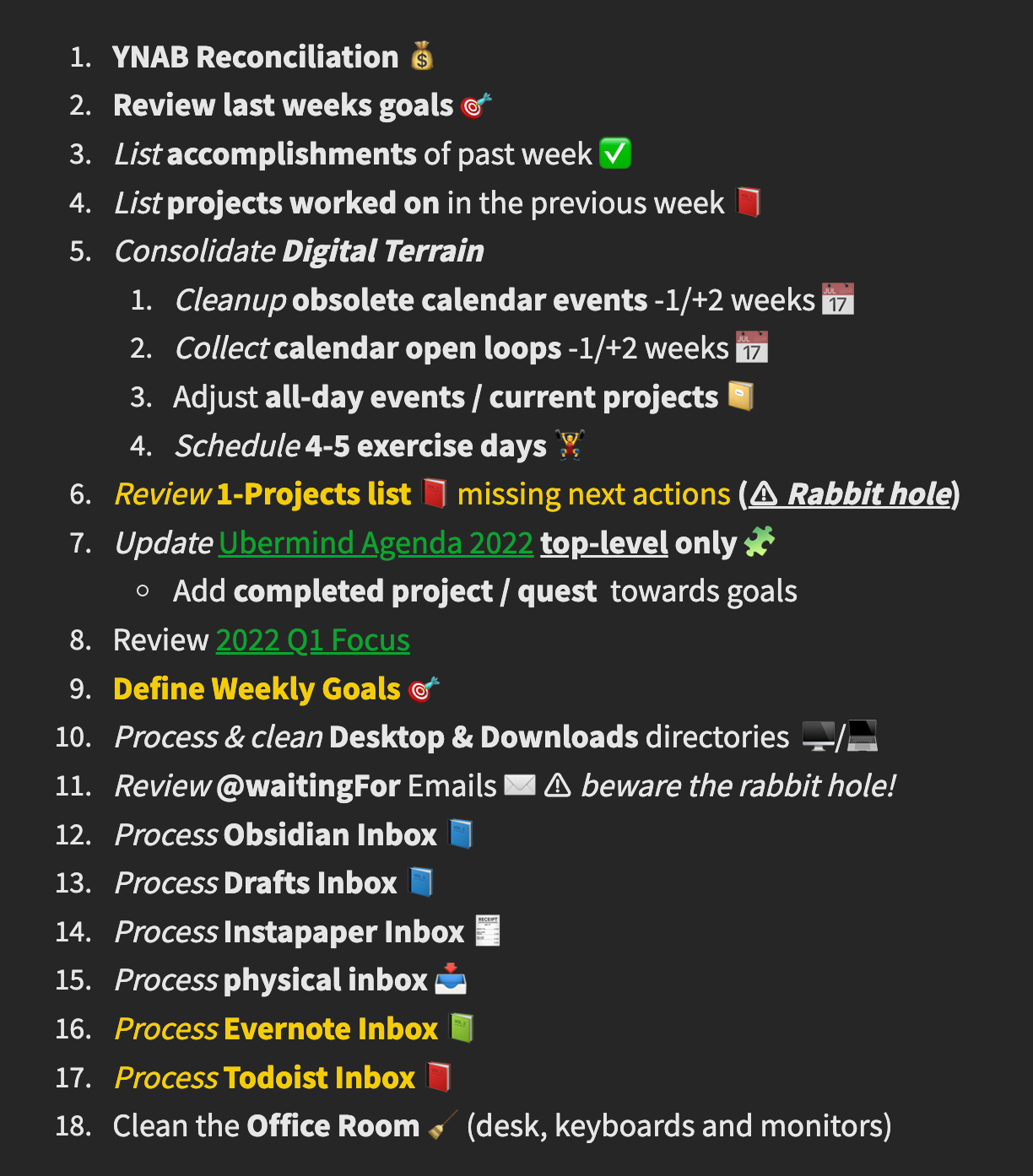
It all started as a short & simple checklist. But over time, it morphed into a quite long procedure. Next to clearing inboxes, my review included steps like planning the week ahead, connecting to a longer-term vision, and maintaining quantified self-tracking, …. Even cleaning the office room was in there for some time.
The reason: I was at a quite divergent phase of getting my productivity systems up and running. I added everything I deemed interesting or randomly stumbled upon. I added stuff that worked for other people.
The downsides are obvious (at least to someone looking from the outside). This review took me around 90 minutes and a lot of energy. And a lot of it was in vain since I didn't really make use of it later on.
Now, don’t get me wrong. I don't think that going through this was a bad thing.
I deem exploration to be a necessity before cutting things down to their essence and start exploiting.
And I'd also advise you to vary of people who tell you otherwise.
If someone refines their system over the years, it includes a high level of personalization. It’s often presented to you completely out of context. You don't know what other systems the person has in place. You don't know how many steps the author has internalized and doing additionally without being aware of it.
You can copy their system as a starting point. But you will almost certainly have to expand from that first before you can later remove all of the non-essential. So, while expansion is a highly probable occurrence, the question remains: how do you transition from convergence (putting more into your review) into divergence (removing things from your review)?
This is where magnitude tuning enters the game.
Once I applied it, things started to change. Over several months, my weekly review slowly became more concise and appropriate. This is how it looks today:
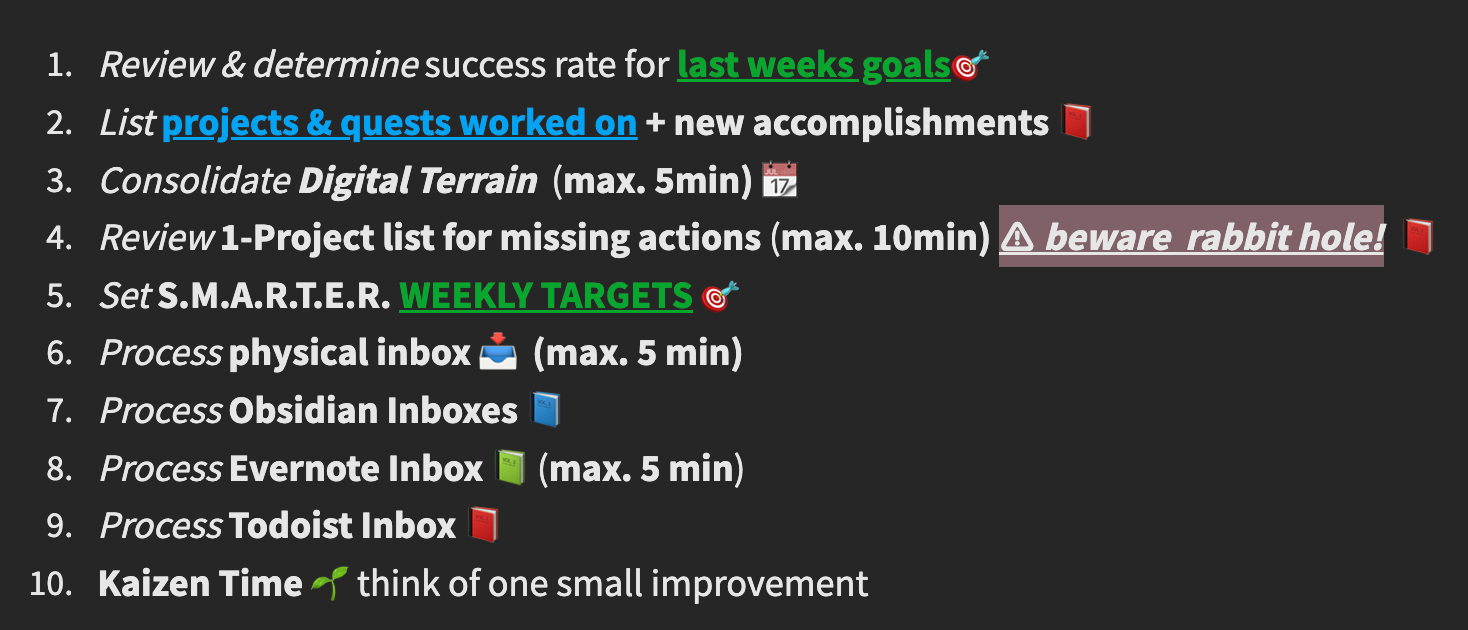
It’s a concise 10-step checklist I usually complete in 40 minutes or less.
Changing from the old review checklist to this one took some time, but it was not a lot of work.
Here are some personal examples from my transition:
At one point, I realized that checking my finances weekly ("YNAB Reconciliation") was too cumbersome. I needed to switch to another app, breaking the whole flow of the review. It also did not add that much value to the time horizon. Checking all my in and outflow was better suited for a monthly cadence. When I realized this, I added it as a to-do in my task manager.
Sometimes, the opposite was the case. At one point in my monthly review, I realized that monthly goals don't quite work for me. So I wanted to try out weekly goal setting, and just in time, I added a task to move goal setting to my weekly review.
Another time, I realized that cleaning my desktop once a week was not as important anymore (often, it would already be clean, or there would only be 1-2 files), so I made it a low-priority recurring task in my task manager and removed it completely from the review.
Solving issues of digital hygiene often means moving checklist items between magnitudes. Sometimes, I can remove items if they don't provide enough value. Very rarely do I add new items. By doing that, I can tune my routines incrementally until I reach a point of temporary equilibrium.
While changes like this happen organically on some occasions, the key moment of my transition was when I added a little action step to the end of my checklists. I called it "Kaizen Time". It was simply about spending 1 minute thinking about how I could make the checklist just a little bit better this time.
This was the necessary trigger for me. It made me zoom out to one level above the weekly review, a key requirement for actually improving it.
I became aware that different action steps require different thinking levels. Then, with this awareness, I went on to magnitude-tune my weekly review bit by bit. I started removing any steps that required thinking too low or too high, steps that didn’t fit the overall thinking level of the review. I started shifting steps to other places (like my monthly review or task manager).
Since the kaizen step is at the very end of the review, it did not disrupt my flow too much—quite the opposite. Zooming out became a nice finisher for my weeklies. It was somehow fun, and it made me aware that I want to be on a triage-kind of thinking level during the review. I am not on the level of actually engaging with and processing every item in our inboxes. Instead, I only want to decide what kind of item something is or where a given item in our inbox should go. I am also not at the level of thinking where I brainstorm or conceive new goals; instead, I derive them from pre-planned, longer-term guidance.
That said, I don’t think my weekly review is “fully tuned.” It will continue to shape-shift, albeit at a slower pace. It’s always only a temporary equilibrium.
Also, today, we only looked at one way of magnitude tuning it: adding a kaizen step at the end. Looking back, I see that I used a couple of other tactics. For instance, once in a while, I quantify the time it takes to complete each step. I do that throughout a couple of weeks and calculate an average time. That average time then informs my decisions on which steps need improvement.
But these are only the ways that worked for me. Maybe it helps some of you out there. Maybe not. Maybe you don’t even have a weekly review. So, in the next article, we will look at another example. I will show you how magnitude tuning helped me find my goal-setting cadence.
If you like what you read, please give it a heart or share it with some of your friends. Until next time!
Really enjoyed this one Dennis, I can see now how Magnitude Tuning can be use for my creative work. Well everything is, even how you improve your steps to process your weekly review and items on those lists is very creative. Will strike some Kaizen into my lists or things I do! What one effect could make a difference.