

In the last post I showed you how it took me five years to get "ready" for magnitude tuning in my personal goal-setting output.1 Today I will show you how I iterated from that point to where I am at now.

Let’s start with a quick recap: 2019 was the year I first settled on a personal approach to annual goal setting. The goals it produced looked like this:
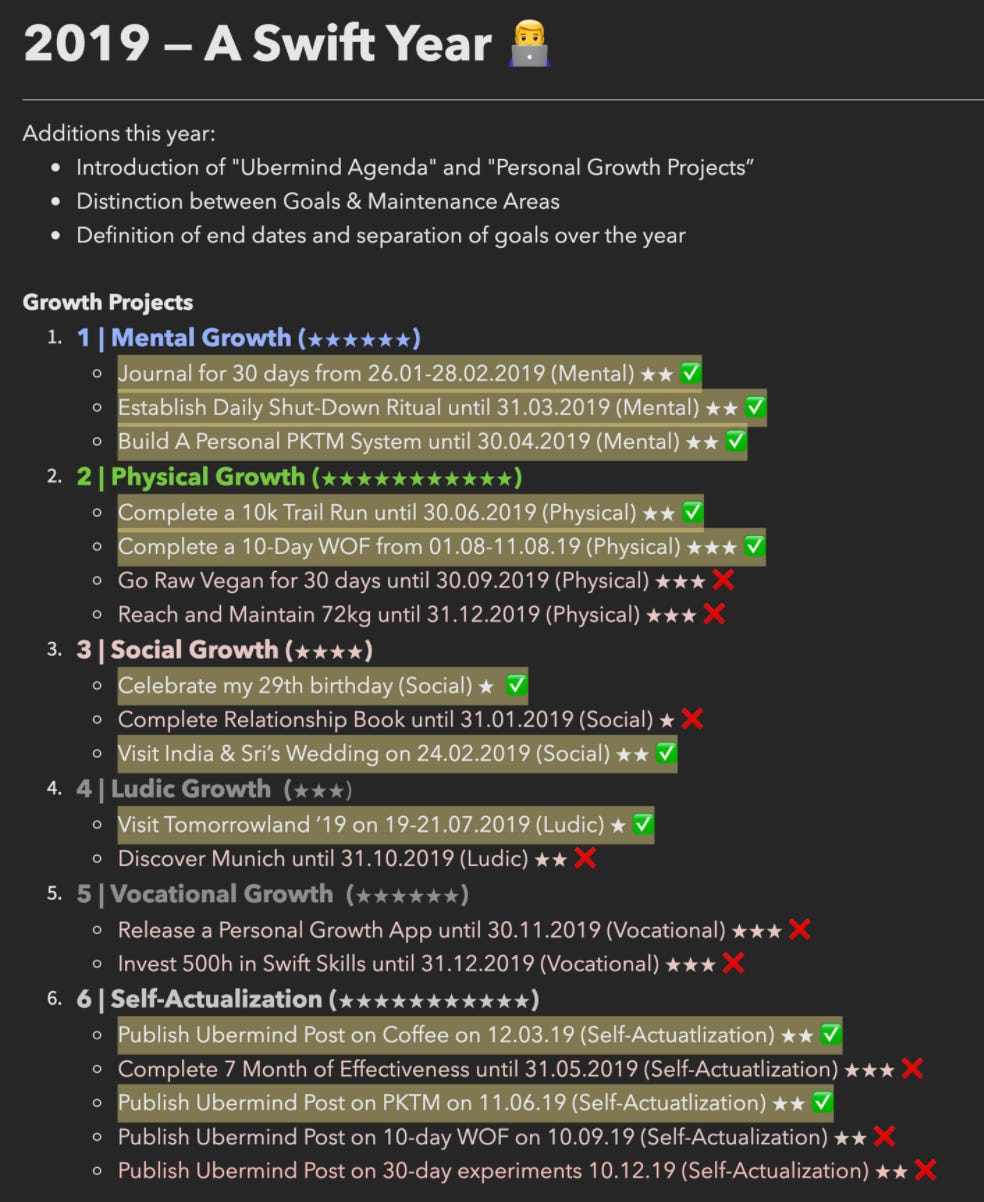
19 S.M.A.R.T. goals, grouped into six life realms. An additional section at the top called "Additions this year" lists all the changes compared to the previous one.
Let's discuss now how I have further tuned this over the last few years.
2020 — Project-based Goals
Reflecting on how 2019 went, I determined I had performed poorly at longer-term goals. So, I wanted to make my goals even smaller. I broke them down to a “project-size” level. As you can see, the result was a list of small targets for the year:
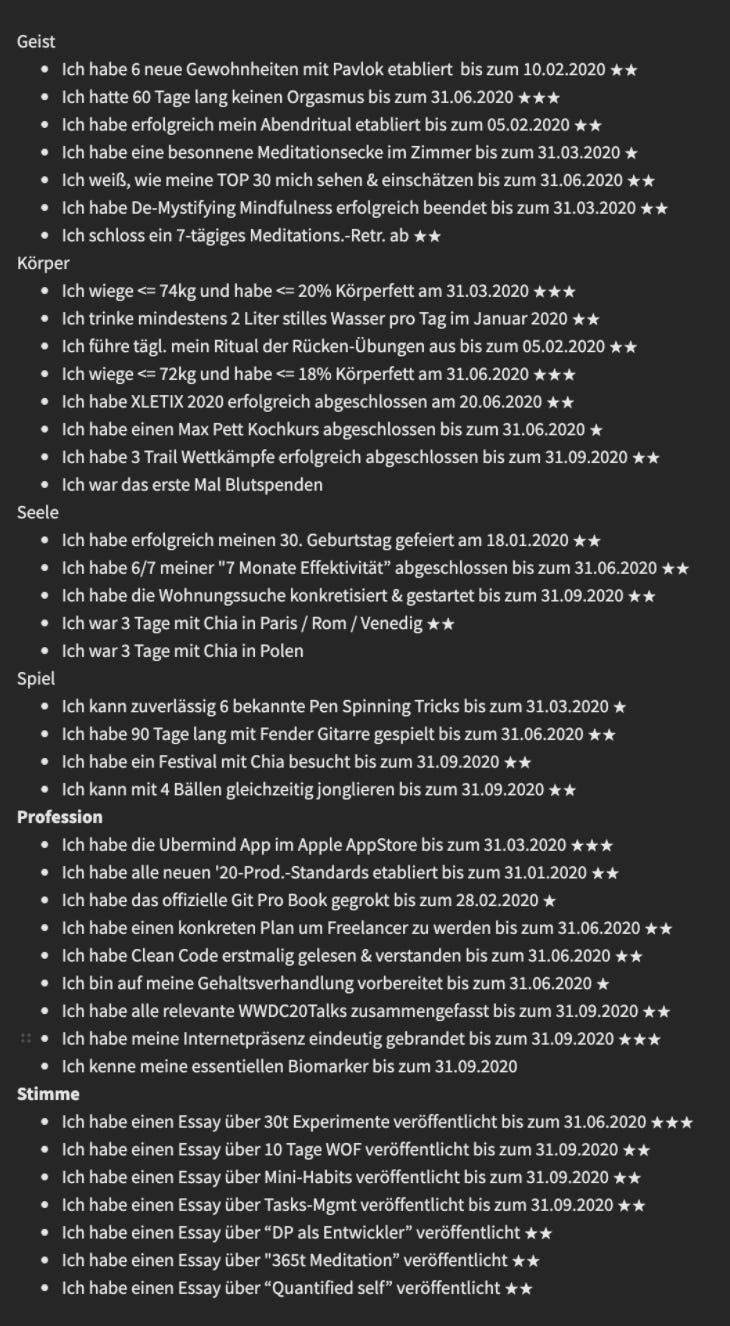
Every goal was now a project. I thought this would help me predict and perform better, and it would be a more agile and flexible solution.
But it had the opposite effect. This list was completely overwhelming, un-"glanceable", required way too much upfront planning, and offered way too little flexibility and leeway. It was unfortunate that this was 2020, an unusual year for everyone. But even without COVID-19 rendering many of my goals impossible, 2020 would have brought disruptive changes. For instance, I developed a serious health condition and sundowned my first blog (which gave me unexpectedly more room for new projects).
So, in 2020, like many others, I had to do a mid-year replanning for the first time. I took this opportunity to revert back to something more like in 2019. But I also made some changes in this replanning. I tested out "Goal types" and focus quarters (which quarter I would dedicate to which goal). I added a "couple goal" (to work toward together with my girlfriend), and I also made another visual change in the re-planning, a table with background color (as you can see below).
2021 — Introducing OKRs
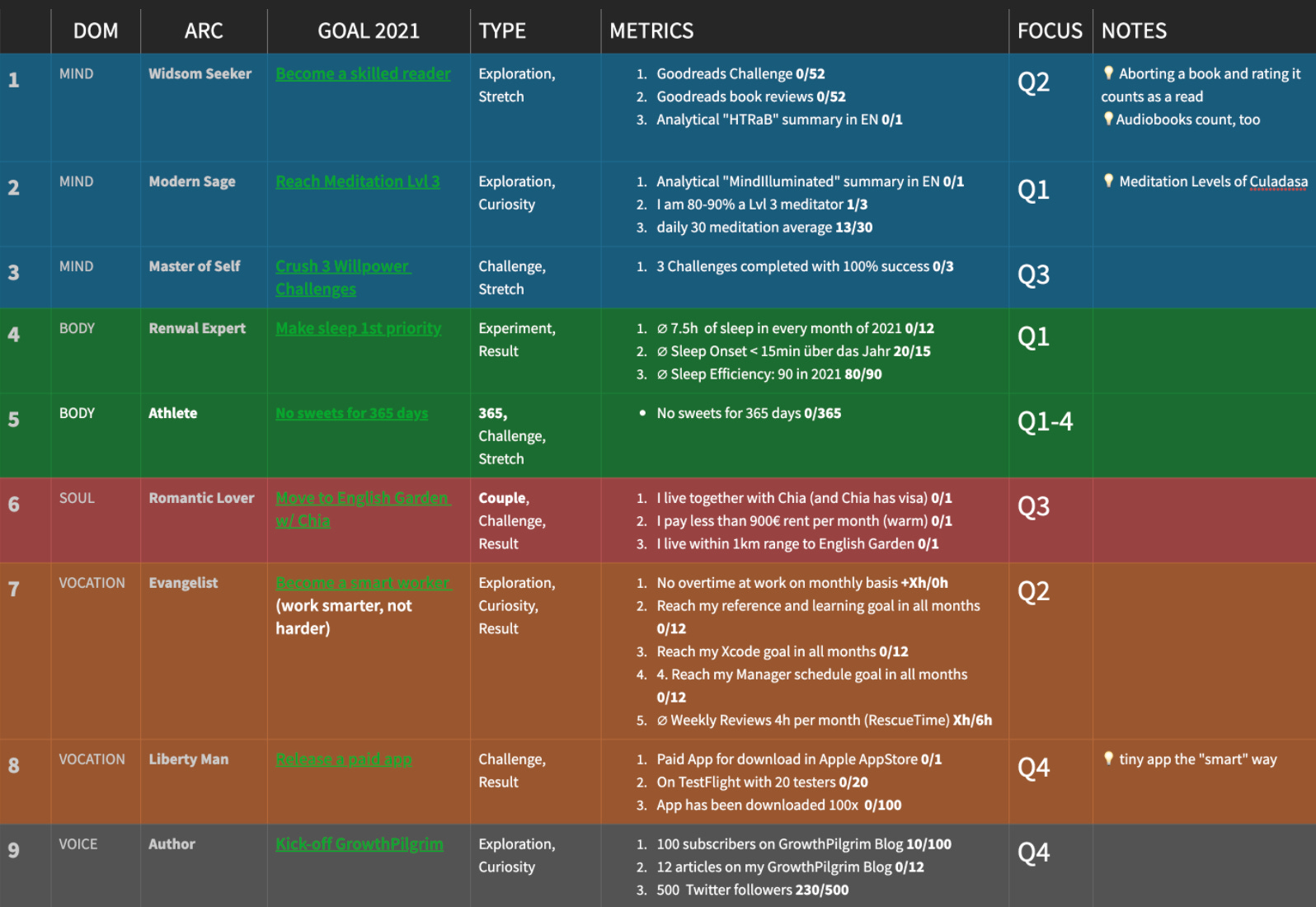
In 2020, I learned to value replanning and course corrections throughout the year. I also—yet again—overcommitted myself, partly because I had lost sight of my goals. So, for 2021, my biggest change was replacing my S.M.A.R.T. goals with proper OKRs. That meant that I basically set a more vague direction (objective) instead of a goal. But then supplement that objective with three concrete metrics (key results) to score each goal against. This is what my goals looked like for 2021:
2022 — Pruning to the Essential
Finally, this is how my goals for 2022 look like:
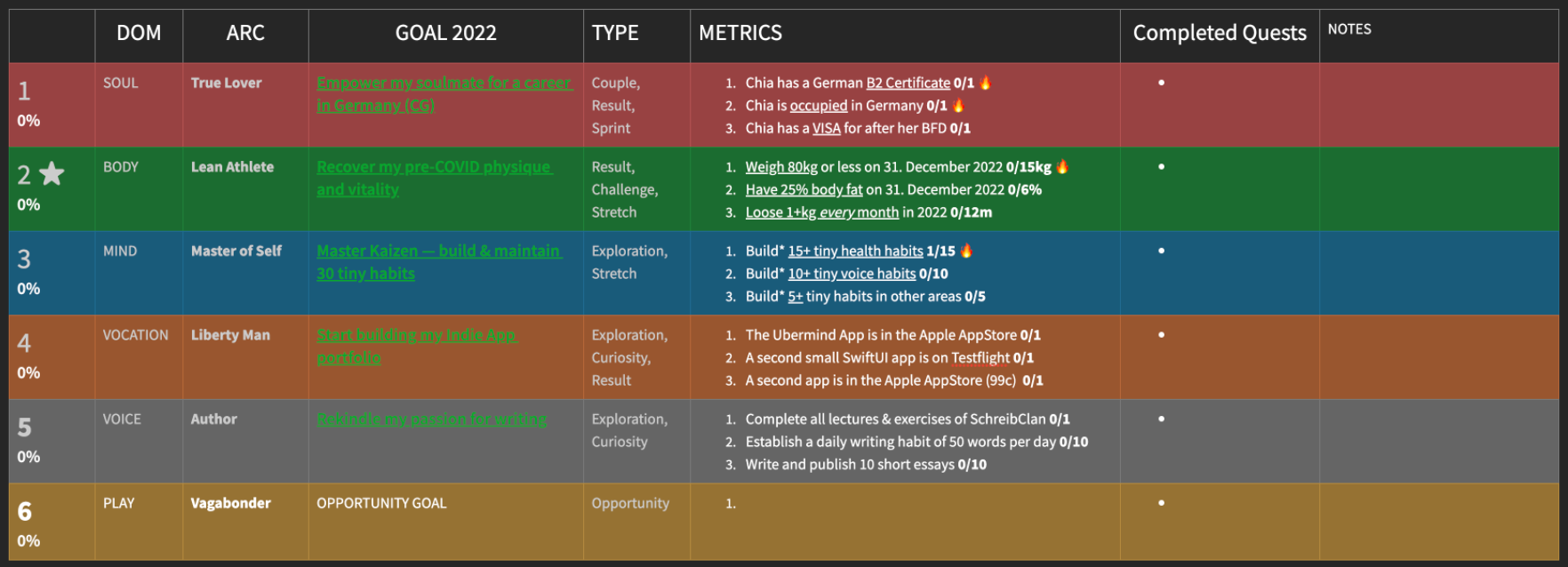
Last year, I once more overcommitted myself, and my goals were still not visible enough. So, for 2022, I reduced the total number of goals to only 6 and condensed everything down a bit. I even left one slot blank to account for a big, unexpected opportunity throughout the year.
Note that fewer goals do not indicate less ambition. As the number of goals shrank, I naturally increased the difficulty and size of each goal.
In the previous post, I wrote that magnitude tuning is a "fine calibration on the surface of things. It's about efficiency, not effectiveness." This is exactly what we can observe here. Consider each of my OKR metrics to be a S.M.A.R.T. goal in itself. So this amounts to 18 distinct targets or endeavours, which almost exactly matches the number of goals I had in 2019. It's just the shape—the structure, not the content—that changed!
This is an important point I want to stress again:
magnitude tuning won't make you better at setting goals. What makes you better at goal setting is experience, best practices and experimenting with proven methods like SMART goals or OKRs.
But what magnitude tuning can do for you is make you more efficient.
Structural changes like the one I performed are valuable because they affect how we interact with the content. In the case of goal setting, my metamorphosis from 19 distinct goals in 2019 to only six with three metrics each in 2022 allows me to manage the workload better. Planning out only 6 goals in detail allows for much more depth. Six items are also a lot easier to keep mentally visible.
I am now probably nowhere near an optimal personal goal-setting practice, so my iterations will continue for the foreseeable future. This is another reason why I call this tactic magnitude "tuning." You are never quite done with it. There may not even be such a thing as an optimal personal cadence. A year may be a good base cycle when you are in school. But then you become a student, and suddenly, semi-annual planning will probably way better align with your semesters. But then you start to work within a fast-paced startup culture, so now quarters or even months may suit you better.
So maybe there are only well-suited cadences for your current lifestyle.
If you practice magnitude tuning long enough, everything will opt out in a nice equilibrium sooner or later. But it does not mean that you won't need bigger changes once in a while. Life unfolds in seasons. Everyone undergoes big transitions. And, of course, life is also chaotic. Change inevitable. You never know what life has in stock for you.
Other Time Frames
What you can't see in the above evolution of my annual goal setting is another important effect of magnitude tuning. It's the raised awareness of the fractal nature that goal setting has to it.
The most commonly discussed cadence for goal setting is the annual one. Yet, depending on your lifestyle, type of work, and preferences, you may want to set goals for any time horizon.
The most obvious and popular ones are daily/weekly/monthly/quarterly/yearly goals. But I encourage you to experiment with bi-weekly, bi-monthly, or half-year periods. Maybe they suit you better.
The key points here are that you don't need to choose only one and you don't need all of them.
The great thing is that once you are "ready" for tuning on one level (e.g., the year), you are ready on all levels. So, trying out these other goal-setting cycles is actually quite easy. You essentially do the same thing but for shorter time frames.
The important thing is that you keep experimenting.
For example, I quickly realized that monthly goals don't work for my lifestyle, but quarterly and weekly goals stuck.
I like weekly goals because they go hand in hand with my weekly review. Additionally, having at least one short-term goal-setting cadence in addition to the yearly one helps you get better at goal-setting as this is the only way to get feedback and iterate. Then, you make one small adjustment to your system. One small change to try out for the next few iterations.2
I like quarterly goals because three months is usually how far I can usually "see." Anything longer has a much greater unpredictability. Almost every year in my life brought at least one major unexpected change with it. Quitting my job, having major health issues, moving in with my girlfriend, and starting my first blog. While I expect such changes to get fewer as I grow older, disruptive changes like COVID-19 will always be a reality. If I look at a single quarter, such changes are much less likely to occur. A quarter is also usually long enough to get something big done while not burdening me too much with planning and management overhead.
But for you, it may be very different. You have to find your very own cadence.
Luckily, the tuning process is always the same and works for everyone in every situation.
You start with some proven system and then slowly adapt your workflows to how you think, behave and feel. You do that while engaging in the goal-setting practice and reviewing your previous iterations. You zoom out one level above the actual magnitude your are trying to plan. And if you realize any friction or mismatch you somehow mark it to be improved for the following iteration.
That's it. I am sure there will be more posts about this in the future, but for now, this is all I have to say about magnitude tuning. I hope you enjoyed this series.
Please let me know what you think, either by replying to this email or by adding a comment on the web version.
A quick reminder: in this article series, we did not look at how I actually set goals but only at the output of my goal-setting practice. This is both for stylistic reasons (not overcomplicating things) and the fact that I have not settled yet on anything that is easily communicated. It's a messier process, and I haven't reached “tuning readiness” yet.
Getting better at annual goal setting is hard since you have little practice/repetition. You get extremely delayed feedback since you do it only once per year. You get it one year later, if at all. And lastly, you are not very likely to discover magnitude tuning. You are tempted to use a new shiny method you discover towards the end of every year instead of iterating on your method.
I since wrote a post on this:
