The Cost of Growing Up
Your productivity system was never supposed to be finished.
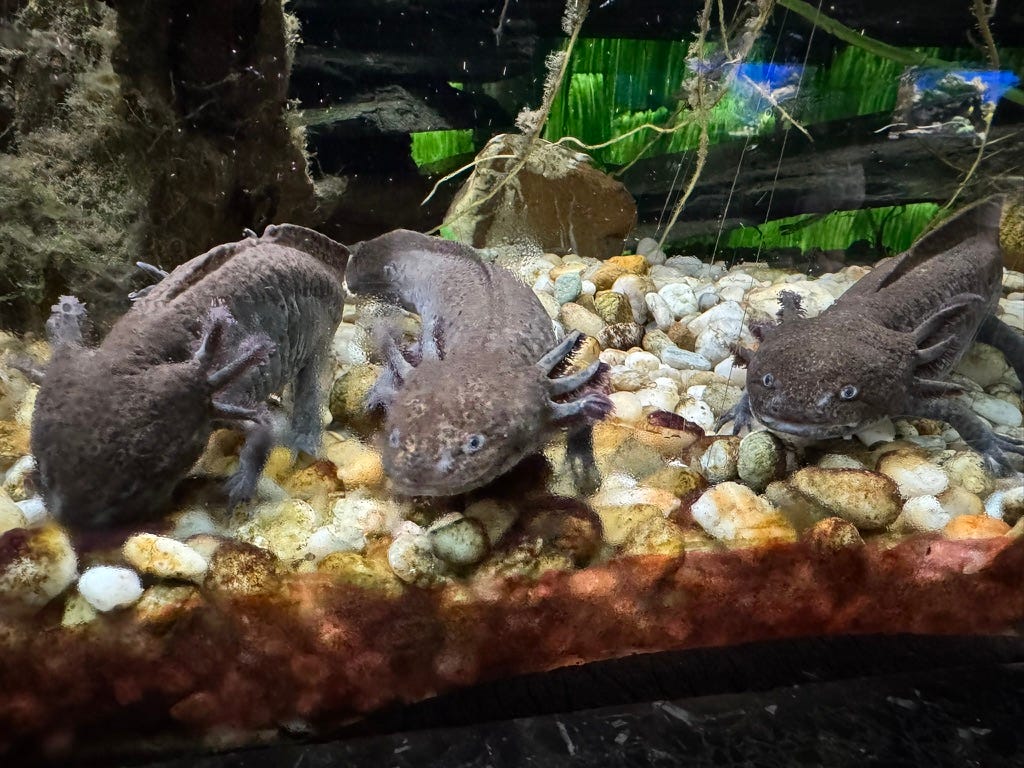
My son is obsessed with axolotls. He’s three, and our recent visit to the zoo convinced him that this is the animal. The best animal. The only animal that matters.1 So, as it goes, he now owns a book, a plaything for the bathtub, a cuddly toy he can take to bed and, above all, a quiet certainty about it all. I don’t blame him. He’s right. There’s something fascinating about these creatures — an amusing oddness, a cartoonishness even, and the longer you look, the stranger they become.
At this point, I’ve probably learned more about them than any adult without a biology degree ever should. In a nutshell, axolotls are Mexican salamanders that never grow up. To fully appreciate what that means, you need to understand metamorphosis — the biological process by which an animal transforms from a juvenile form into its adult one. Caterpillars go land-to-air: they cocoon themselves and get wings. Salamanders go water-to-land: they lose their gills, develop lungs, and leave the water behind.
Water-to-land is what should happen to the axolotl. But it doesn’t. The animal reaches maturity, reproduces, and can live for years, all while staying in what biologists call its larval form. That’s like a caterpillar that never becomes a butterfly (these exist, too). In the case of the axolotl, that means they keep their gills, soft bodies, and that faint, permanent half-smile for all of their life.
Force an axolotl to grow up, and it breaks
The academic term for what happens with the axolotl is neoteny: reaching sexual maturity without undergoing metamorphosis and retaining juvenile traits. It sounds like a flaw, or at least an unfinished state. But the axolotl isn't broken. It isn't waiting to complete a missing step. By every functional measure, it is fully formed. It just doesn't match our idea of what a finished animal is supposed to look like.
In fact, the axolotl is not just not broken. It has a superpower that’s hard to ignore once you see it: it can regenerate and regrow almost all kinds of tissue. If it loses a limb, a tail, even parts of its heart or brain — it regrows these cleanly, from scratch. Most animals can do small repairs: close wounds, form scar tissue, and adapt around damage. The axolotl, due to its “juvenilization” and always maintaining its larval form, regrows tissues from scratch, leaving no visible traces of the injury and no accumulation of errors.
These two traits — the refusal to mature and the ability to rebuild — are not a coincidence. Researchers at Northeastern University tested it directly. They took a group of axolotls and forced half of them to undergo metamorphosis using thyroid hormones that axolotls naturally lack. The axolotls that “grew up” regenerated at half the rate of their larval siblings, and their regrown limbs came back wrong with missing digits, malformed carpals, and other structural defects.2 So growing up didn’t just cost the axolotl its flexibility. It cost them the one thing that made them remarkable.
Towards Neotenic Systems
I didn’t dig that deep into axolotls because I care about salamander endocrinology. Nor because my son keeps bringing up axolotls. I was fascinated by the whole animal because it reminded me of a pattern I’d seen elsewhere, namely, in how people treat their houses, their bodies, their relationships, and their minds. We want things to be finished. We want to train and eat until we reach a healthy body, and then keep it until we die. We want to practice meditation to reach enlightenment and then stay calm for the rest of our lives. We want to fall in love and marry so that we can then sustain a perfect relationship till death do us part. Above all, maybe, we want to reach happiness and stay happy until we die. The idea that these things have a final form that can be reached and “locked in” is so deeply embedded that questioning it feels almost ungrateful.
In personal productivity culture this takes a very specific shape. Companies are selling all-in-one apps, and individuals offer sophisticated templates and pre-packaged AI workflows. And some of these products may indeed help some people some of the time, though I suspect only a very small percentage of those who actually pay for them ever gain anything in return. The real problem I have with these offerings is the idea that people sell together with their products. An “all done-for-you” Notion template that helps you manage your entire life brings with it the framing that such a fully formed and “finished” productivity setup is even possible. That systems and workflows can be perfected and then pay dividends for life.
In biology-speak, the message is that your system should undergo metamorphosis. It should lose its juvenile gills. It should emancipate itself. And learn to walk on land. Your system should morph into the finished salamander, the butterfly with wings. And people buy into this willingly, because they want to solve productivity once and for all, so that they can move on to other problems. In turn, however, they lose the ability to regenerate. They harden and overfit their systems to current circumstances, cement their workflows, and thicken their habits around a certain setup that seems to work in any given moment.
Eventually, however, things break. They always break. Sometimes, because of a big life change that wrecks a system so completely, there’s nothing left to regrow from. But more often it starts small: a single lost habit, a bug in a tool, some friction in a workflow. Tiny wounds can heal, but over time, paper cuts cut deeper and deeper. That’s why most people’s systems are scarred all over. That’s why they have spikes where there should be limbs. They are a ticking time bomb waiting to detonate. All because their system was designed to be done. And done systems, when they break, produce spikes instead of limbs. The only way out: declare bankruptcy and start over in a shiny new app. That might feel like neoteny, but it's actually more like euthanasia. You're not regrowing the limb. You're putting the whole animal down to buy a new one.
The axolotl’s biology suggests a different design principle. Our systems should be evergreen, perpetual work-in-progresses. Our systems should be considered fully functional without ever being finished or finalizing their form. They should be neotenic.
The Problematic Hormone
Most productivity systems out there are not neotenic in this sense. Because people want the finished salamander, gurus can sell them metamorphosis-in-a-bottle. The ultimate setup. The best of the best. The last system you’ll ever need. A neotenic system, in contrast, and by definition, is never finished. Something you work on for the rest of your life. This idea is not sexy, and it’s almost impossible to market.
This, by the way, is anything but an excuse to stay a beginner forever. The axolotl isn’t immature. If anything, it’s amature3. It hunts. It reproduces. It lives for two decades. It does everything a finished salamander does — without hardening into a form that can’t change back. It remains plastic. The productivity equivalent of immaturity is the person on their fourteenth app migration who hasn’t shipped anything. The person who builds tracking dashboards for work that never starts. The person who optimizes their goal-setting process instead of setting goals. That’s not neoteny. That's not staying larval. That's never even leaving the egg.
The axolotl doesn’t try to grow up. It doesn’t keep switching lakes. It lives in one lake, remaining fully functional in larval form throughout its life. But the axolotl doesn’t choose to stay larval, either. It doesn’t resist metamorphosis through discipline or mindset. It’s simply missing the hormone that triggers the metamorphic cascade. Neoteny isn’t something the axolotl actively does. It’s the absence of a trigger. So productive neoteny isn’t about learning how to stay flexible. The real question is: what trigger do we need to remove to become axolotls?
That trigger is your belief that your productivity system will be finished at some point. That's your thyroid-stimulating hormone. Once it floods the system, the cascade is hard to stop.
If you believe there is a final or ultimate form of your system, you will, many times over, decide that your system is now “done” and stop working to improve it. This belief is also what makes off-the-shelf systems so seductive — an all-in-one app, a guru’s template, a pre-built workflow. If a finished system is possible, why not buy one that’s already there? Of course, in the end, things don’t hold. And the routine you spent months building is suddenly gone. But instead of regrowing it, you tell yourself you already did that. You did the work, and it didn’t work. So why bother doing it all over again? The finished-system myth blocks you from seeing that a system that doesn’t work is simply a system with a lost limb. A limb that can be regrown, if the system was never designed to be done. But yours was. The system you built was done. And it didn’t work. So you don’t bother to repair — you abandon. You stop iterating because the system was supposed to be done. You throw away past work and start over, rather than reshaping what's there. Your productivity gills have hardened into lungs. And lungs can't turn back into gills.
Remove that one belief — that your system can ever be finished, that it will finally grow up and be perfect — and you don’t need to learn flexibility. You just stop calcifying.
Scale-Smart Systems are Neotenic
Most productivity systems hand you a fixed form. A next-actions list. A weekly template. A project board with prescribed columns. These are metamorphosed containers — they work as long as your circumstances match the author’s assumptions. David Allen’s next-actions list, for example, is a great idea if you are a disciplined person who juggles hundreds of small moving pieces. But the moment your main work shifts to a single deep project — writing a book, say — an ever-growing list of tiny actions no longer helps you. It distracts. The container was built for one context and hardened into that shape.
A scale-smart system, as I propose it, works very differently. Instead of thinking in fixed containers, you think of all your work in flexible scopes — boundaries that expand, contract, split, and merge in response to actual demands. In my book, I call this Effort Scoping: treating your work as a set of flexible sets of intentions you can reshape without tearing down the whole structure. You can grow sophisticated systems when life demands it, but otherwise stay as simple and lean as possible. Your effort scopes are never finished. They leave and regrow based on your needs.
Effort Scoping and many other ideas I’ve written about4 help you move towards an axolotl’s soft body instead of the salamander’s hardened skeleton. That’s nimble modularity instead of knitted castles. The underlying principle is the same across all of them: your system should never reach a final form. It should do everything a finished system does, but without hardening into one that can't change back.
The cost of growing up
You’ve seen it. Everything automated. Templated. Linked. Metamorphosed. But when life changes a tad too much, the templates assume workflows that no longer exist. The databases reference dead projects. Bullshit notes accumulate. Pseudo-tasks proliferate. Regrowing limbs would mean tearing everything down, so you don’t. Or you do, by starting over in a shiny new app.
My son doesn’t know about thyroid hormones, neoteny, or regenerative capacity. He doesn’t know about productivity or even what it means to grow up. He just sees an animal that smiles and never has to become something else. He’ll grow up. He’ll “metamorphose” through puberty— that part’s not optional. But his systems don’t have to. The best ones never do.
Dive Deeper
This fortnight and maybe the next.
Monaghan, J. R. et al. (2014), “Experimentally induced metamorphosis in axolotls reduces regenerative rate and fidelity,” Regeneration 1(1), 2–14.
A-mature, not im-mature. Fully functional without being finalized.
Before I researched axolotls and encountered neoteny, I didn’t realize that this was a missing thread in my work. Neotenic design, the idea that you keep your system open for change and don’t lock in to any final form, runs through all of my work. I’ve spent years building components for this kind of system, and I’ve shared many of them on this Substack and in my book. Most notably, I created the ACE framework for vertical life design (a neotenic improvement over GTD), the ±PEAKER org method for mastering digital life (as a neotenic improvement over JimmyDecimal, PARA & ACE), and my practice of magnitude tuning™ for making iterative progress through the Japanese spirit of kaizen. If you want to go deeper on any of these, I have listed them at the bottom of this essay. My book also goes deep on all of these and weaves them into a coherent whole.